
Hyaluronic Acid Injections for Knee Osteoarthritis: Do “Joint Lubricant” Injections Work?
- Dr Mohammad Jomaa
- Jul 5, 2026
- 8 min read
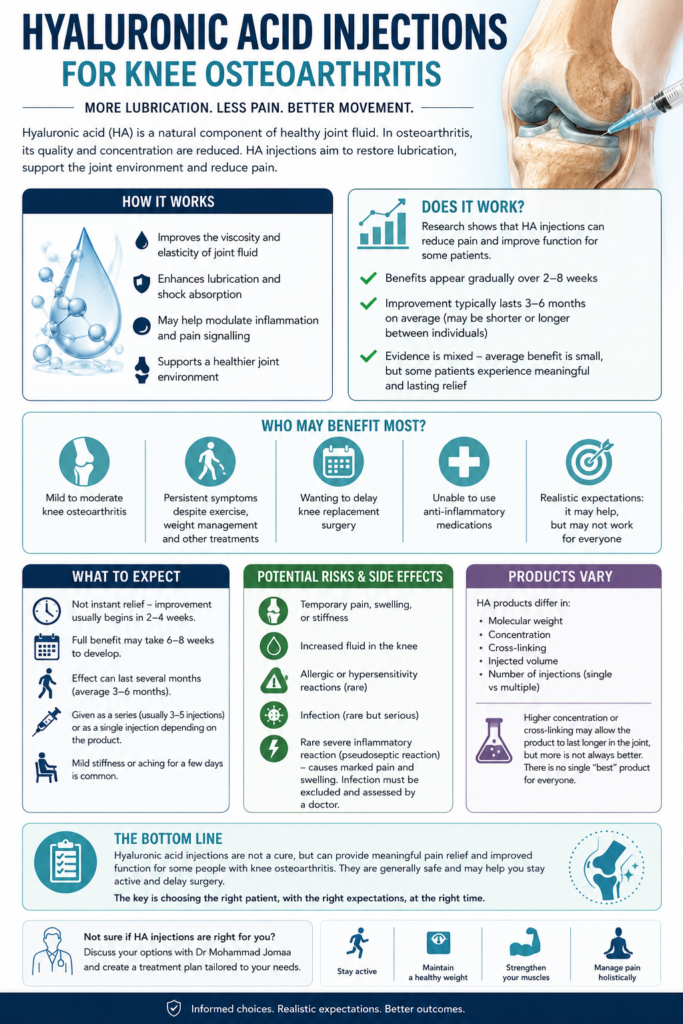
Hyaluronic acid injections are among the most established injectable treatments offered for knee osteoarthritis.
They are sometimes described as viscosupplementation, or more simply as “joint lubricant” injections. They have been used for several decades, remain popular with many patients, and are generally considered safe.
However, the evidence surrounding them is more complicated than either saying that they definitely work or that they are entirely ineffective.
Some patients report substantial and prolonged improvement. Others notice only a modest benefit—or no benefit at all.
Understanding what the treatment can reasonably achieve is therefore important before deciding whether it is worth trying.
What is hyaluronic acid?
Hyaluronic acid is a naturally occurring substance found throughout the body, including in the skin, eyes, cartilage and synovial fluid inside joints.
Within a healthy knee, it contributes to the thickness, elasticity and lubricating properties of the joint fluid. It also has biological effects on inflammation, pain signalling and the behaviour of cells within the joint.
In an osteoarthritic knee, the natural hyaluronic acid within the joint becomes more fragmented and the synovial fluid may become less viscous and less effective at absorbing load.
A hyaluronic acid injection introduces a manufactured form of this naturally occurring molecule directly into the joint.
The intention is not simply to add “oil” to the knee. Although lubrication is part of the explanation, hyaluronic acid may also influence inflammation, pain sensitivity and the internal environment of the joint.
Does hyaluronic acid repair arthritis?
Hyaluronic acid injections should not be presented as a cure for osteoarthritis.
They have not been conclusively shown to regrow lost cartilage, reverse established arthritis or permanently prevent the need for joint replacement.
Their main purpose is to reduce pain and improve function.
Some laboratory and clinical studies have suggested potentially favourable biological effects within the joint. However, we do not yet have sufficiently strong evidence to promise patients that the treatment reliably slows structural progression.
It is therefore best considered a symptom-management treatment, rather than a cartilage-restoring treatment.
How effective are hyaluronic acid injections?
Hyaluronic acid injections are very popular amongst patients, and many patients will swear by their efficacy. Most sports physicians will report good to excellent pain relief in a majority of their patients lasting up to 12 months, but this anecdotal evidence often doesn’t easily translate to clear cut outcomes in all controlled studies.
Many individual studies have reported improvements in knee pain and function after hyaluronic acid injections. However, when the results of large numbers of trials are combined, the average additional benefit starts to look less compelling.
This has led several major medical organisations to recommend against its routine use in OA as a first line treatment.
However, this does not mean that nobody benefits.
Clinical trials report average results across large groups. They do not perfectly predict what will happen to each individual patient. In practice, there appears to be a group of patients who experience worthwhile relief, sometimes after other conservative treatments have been unsuccessful.
The difficulty is that we cannot always predict in advance who those patients will be.
For this reason, hyaluronic acid remains a reasonable option for selected patients provided that the limitations, costs and uncertain probability of improvement are clearly discussed.
Who may benefit most?
Hyaluronic acid injections are generally considered after the foundations of osteoarthritis management have already been addressed.
These include:
- appropriate strengthening and aerobic exercise
- weight management where relevant
- activity modification
- treatment of contributing biomechanical problems
- suitable pain-relieving or anti-inflammatory medication
- management of sleep, general health and metabolic risk factors
The treatment may be considered in someone who:
- has persistent symptomatic knee osteoarthritis
- has not obtained sufficient relief from rehabilitation and simpler treatments
- cannot take anti-inflammatory medication, or wishes to reduce reliance on it
- wants to avoid or postpone surgery
- understands that the treatment may not work
- does not have an infection or another contraindication to injection
Results may be more predictable in mild-to-moderate osteoarthritis than in severe bone-on-bone disease.
Patients with advanced osteoarthritis may still choose to try it, particularly when they are unable or unwilling to proceed with knee replacement. However, expectations should be more guarded.
How quickly does it work?
Unlike cortisone, hyaluronic acid does not usually provide immediate relief.
Some patients begin noticing improvement within two to four weeks. The benefit may continue to develop over approximately six to eight weeks.
When it works, improvement is commonly reported for several months. Some patients describe relief lasting six months or occasionally longer, but a full six to twelve months of improvement should not be guaranteed.
Others obtain little or no meaningful benefit.
This delayed onset is important when comparing it with cortisone. Cortisone tends to work more quickly but is usually shorter acting. Hyaluronic acid usually has a slower onset and may last longer in patients who respond.
Is it really like giving the knee an oil change?
The “oil change” analogy is useful, but incomplete.
Hyaluronic acid does alter the physical characteristics of the fluid inside the knee. It may make the fluid more viscous and improve its shock-absorbing properties.
However, it does not remain inside the knee indefinitely, and it does not simply sit between the bones as a permanent mechanical lubricant.
The injected material is gradually broken down and removed. Any benefit that persists after the material itself has been degraded is thought to relate partly to biological effects on the joint environment.
It is therefore better understood as a temporary treatment that may improve both the mechanical and biochemical environment of the knee.
Why are there so many different products?
There are many hyaluronic acid products available.
They differ in:
- molecular weight
- concentration
- total injected volume
- whether the molecules have been chemically cross-linked
- whether the product is given as one injection or a series
- whether it is produced through bacterial fermentation or derived from avian sources
Cross-linking can make the product more resistant to breakdown and allow it to remain in the joint for longer. Higher-molecular-weight or cross-linked products are sometimes marketed as stronger or longer lasting.
However, it is not accurate to assume that the most concentrated or most highly cross-linked product will always produce the best clinical result.
Studies comparing individual formulations have not produced a universally accepted winner. Product choice may therefore depend on the clinician’s experience, availability, injection schedule, cost, previous response and the individual characteristics of the patient.
Some products require a series of injections over several weeks, while others can be administered as a single larger-volume injection.
What should I expect after the injection?
Most patients can walk out of the clinic after the procedure.
The knee may feel full, stiff or mildly achy for several days. Larger-volume products can create a temporary sensation of pressure inside the joint.
Patients are often advised to avoid strenuous lower-limb exercise for approximately 24 to 48 hours, although ordinary gentle movement is usually encouraged.
Because the treatment works gradually, it is important not to judge its effectiveness during the first few days.
Some patients experience increased stiffness or discomfort for one or two weeks before settling. Persistent or progressively worsening pain, however, should be reviewed.
What are the potential risks?
Hyaluronic acid injections are generally well tolerated.
Possible complications include:
- temporary pain at the injection site
- swelling or an increase in joint fluid
- bruising or bleeding
- temporary stiffness or aching
- allergic or hypersensitivity reactions
- infection, which is rare but potentially serious
- an acute inflammatory reaction sometimes called a severe acute localised reaction or pseudoseptic reaction
A pseudoseptic reaction can cause marked pain, swelling, warmth and restricted movement. It can resemble an infected joint.
Although these reactions are uncommon, a severely painful, swollen or hot knee after any joint injection should be assessed urgently. Infection cannot safely be excluded based on symptoms alone, and aspiration of the joint may be required.
It should not automatically be assumed that the reaction is harmless or treated immediately with cortisone before infection has been considered.
Patients should also inform their doctor about blood-thinning medication, allergies, previous injection reactions, current illness, skin infections or any infection near the proposed injection site.
Can hyaluronic acid be combined with cortisone or PRP?
Some clinicians combine hyaluronic acid with corticosteroid or platelet-rich plasma.
Combining it with cortisone may provide faster early pain relief while waiting for the slower effect of hyaluronic acid. Some studies suggest that the combination may improve outcomes compared with hyaluronic acid alone, although it also introduces the risks and limitations associated with corticosteroid exposure.
PRP and hyaluronic acid combinations have also been studied, with some promising findings. However, PRP preparation methods vary considerably, and the evidence is still evolving.
These combination treatments are best discussed separately because they have different proposed mechanisms, costs and evidence bases.
Is a hyaluronic acid injection worth trying?
For the right patient, it certainly can be.
There are no miracle treatments for knee OA, and like any other intervention, Hylauronic Acid should not replace exercise, weight management, rehabilitation or the broader management of osteoarthritis.
However, HA injections have a favourable overall safety profile and do not carry the same concerns about repeated cartilage exposure that accompany frequent corticosteroid injections. In the right patient, they may delay the need for a total knee replacement and so, for patients who remain symptomatic despite appropriate conservative treatment—and who understand that the response is unpredictable—a trial of hyaluronic acid may be reasonable.
The decision should take into account:
- the severity and pattern of arthritis
- the degree of inflammation in the knee
- previous treatments and responses
- the patient’s goals
- the cost of the product
- whether surgery is currently appropriate
- the realistic likelihood and duration of benefit
The most accurate summary is not that hyaluronic acid injections always work or never work.
Rather, they provide meaningful relief for some patients, modest relief for others, and no clear benefit for a proportion of people.
A careful discussion with a doctor experienced in osteoarthritis management can help determine whether the treatment is a sensible option for your particular knee.
For further information about hyaluronic acid injections and other injectable treatments for knee osteoarthritis, you can book a consultation with Dr Mohammad Jomaa or continue reading the osteoarthritis treatment articles on this website.