Acute ACL Injuries: Why You Might Not Need Surgery
Part 4: The Cross Bracing Protocol
- Dr Mohammad Jomaa
- Jul 31, 2026
- 8 min read
“For decades, tearing your ACL almost automatically meant surgery. Today, our understanding of how this remarkable ligament functions—and, importantly, how it may heal—is changing.”
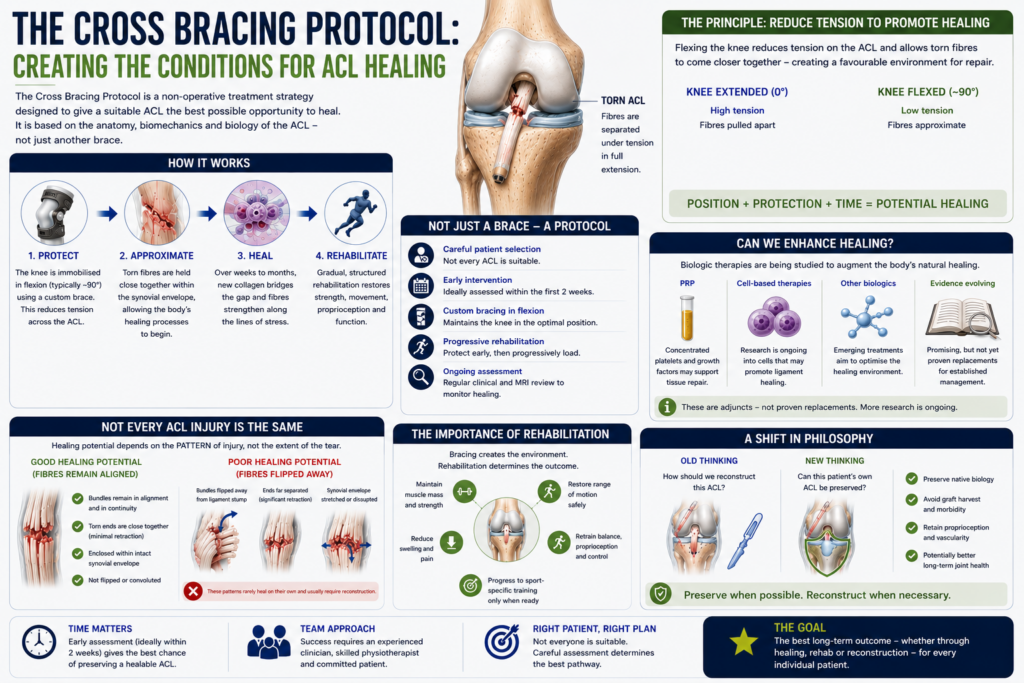
The Cross Bracing Protocol: Creating the Conditions for Healing
If the ACL is a living ligament, then perhaps the question is not simply whether it can heal.
The more important question becomes:
Can we create the conditions that allow it to heal?
For decades, this possibility received relatively little attention. Once an ACL ruptured, rehabilitation focused on reducing swelling, restoring movement and strengthening the surrounding muscles while awaiting reconstruction surgery.
Relatively few clinicians stopped to ask whether the position of the knee itself might influence the biological ability of the torn ligament to reunite.
The Cross Bracing Protocol was developed from precisely this line of thinking.
Rather than immediately replacing the ligament, its aim is to give the body’s own ACL the greatest possible opportunity to repair itself.
Importantly, this is not simply “wearing a brace.”
It is a carefully designed treatment protocol based upon the anatomy, biomechanics and biology of the ACL.
The Principle Is Surprisingly Simple
Earlier, we discussed that the ACL is under greatest tension when the knee is fully straight.
As the knee bends, tension within the ligament progressively reduces.
This has an important consequence.
When the knee is flexed to approximately 90 degrees, many torn ACL fibres naturally move closer together.
Imagine tearing a piece of elastic fabric.
If both ends are stretched apart, healing becomes almost impossible.
Bring the edges back together, remove the tension and hold them in that position long enough, and the body’s normal healing processes have a chance to bridge the gap.
The Cross Bracing Protocol applies exactly this principle.
Rather than allowing the torn ligament to remain under continuous tension, the knee is initially immobilised in flexion, reducing strain across the ACL and allowing the torn fibres to approximate.
This creates a far more favourable biological environment during the earliest and most important stages of healing.
Healing Begins Immediately
One of the most important messages for patients is that healing begins on the day of injury.
The body does not wait until surgery.
Within hours of the rupture, inflammatory cells, growth factors and repair mechanisms are already becoming active.
If the torn ligament has the potential to heal, these first days and weeks are critically important.
For this reason, timing matters.
Patients who may be suitable candidates for ACL preservation should ideally be assessed as early as possible after injury—preferably within the first two weeks.
Delaying assessment may reduce the opportunity to intervene while the ligament remains in its optimal biological state.
This is why early specialist review is so important.
Not Every ACL Injury Is the Same
One of the major advances of recent years has been recognising that ACL injuries exist along a spectrum.
Historically, MRI reports often classified injuries simply as “partial” or “complete” ruptures.
While useful, this classification alone tells us remarkably little about the ligament’s healing potential.
What matters is not simply whether fibres have torn.
What matters is how they have torn.
Some ligaments remain surprisingly well aligned despite appearing completely ruptured.
Others retract dramatically, fold upon themselves or lose continuity within the surrounding synovial envelope.
Some maintain excellent tissue quality.
Others fragment extensively.
These differences are critical.
An experienced clinician reviewing the MRI is therefore looking well beyond the words “complete tear.”
They are assessing whether the torn ligament retains sufficient biological integrity for healing to remain realistic.
This includes examining:
- the pattern of fibre disruption
- the degree of residual continuity
- the relationship of the ligament to the Blumensaat line
- whether excessive sagging has occurred
- preservation of the synovial envelope
- the overall quality of the remaining tissue
These factors often prove more informative than the simple distinction between “partial” and “complete.”
Choosing the Right Patient
One of the most important messages in this article is that the Cross Bracing Protocol is not appropriate for everyone.
It is not a replacement for ACL reconstruction.
It is an additional treatment option for carefully selected patients.
Successful patient selection depends upon several factors.
The injury itself is perhaps the most important.
The MRI must demonstrate an injury pattern that appears biologically capable of healing.
The patient should have sustained a rupture of their native ACL rather than a previously reconstructed graft.
Assessment must also occur early enough that healing remains biologically achievable.
Patient factors also influence decision making.
Age, generalised ligamentous laxity, activity demands, body habitus and skeletal maturity all contribute to determining whether ACL preservation represents a realistic option.
Equally important are the patient’s own goals.
Some individuals wish to avoid surgery if possible.
Others already have surgery planned but may choose to attempt bracing while awaiting their operation.
In adolescents with open growth plates, avoiding tunnel drilling may be particularly attractive if preservation proves possible.
Ultimately, no single factor determines suitability.
Rather, it is the combination of anatomy, injury pattern, biology and patient goals that guides decision making.
Rehabilitation Remains the Cornerstone
One misconception is that successful healing simply depends upon wearing the brace.
Nothing could be further from the truth.
The brace creates an environment favourable for healing.
Rehabilitation determines whether that healing ultimately translates into a stable, functional knee.
Throughout the bracing period, physiotherapy remains essential.
Early rehabilitation focuses on maintaining muscle bulk, preserving hip and core strength, reducing swelling and preventing unnecessary deconditioning while respecting the biological healing process.
As healing progresses, rehabilitation becomes increasingly dynamic.
Range of motion is gradually restored according to the protocol.
Strengthening progresses.
Balance, proprioception and neuromuscular control are retrained.
Eventually, sport-specific movement patterns are introduced before return-to-running, pivoting and finally unrestricted competition.
Whether treated with surgery or bracing, the quality of rehabilitation remains one of the strongest predictors of eventual outcome.
Can We Improve Healing Further?
One of the most exciting areas of contemporary sports medicine is not simply understanding that the ACL may heal, but exploring how we might optimise that healing.
This field continues to evolve rapidly.
Various biologic therapies have been proposed to enhance ligament repair by augmenting the body’s own regenerative processes.
Among the most widely studied is platelet-rich plasma (PRP), which delivers a concentrated source of platelets and growth factors to injured tissue. PRP is well established as an adjunctive treatment that helps stimulate and promote growth, repair and healing in musculoskeletal medicine and early findings are encouraging for CBP patients. However, evidence is still emerging, and patients should understand that these treatments remain adjuncts rather than proven replacements for established management.
Other biologic strategies—including cell-based therapies and regenerative biologics—are also being investigated and can be discussed with your doctor.
The future of ACL management will likely involve not only improved patient selection but also improved methods of enhancing the ligament’s intrinsic capacity to heal.
This remains one of the most exciting frontiers in sports and regenerative medicine.
A Shift in Philosophy
Perhaps the greatest contribution of the Cross Bracing Protocol is not simply that it offers another treatment option.
Its greatest contribution is that it has changed the question we ask.
For decades, clinicians asked:
“How should we reconstruct this ACL?”
Increasingly, we are beginning with a different question:
“Can this patient’s own ligament be preserved?”
That represents a profound philosophical shift.
It moves sports medicine away from automatically replacing injured tissue and back towards supporting the body’s remarkable capacity for healing whenever that is safely possible.
That does not mean surgery is becoming obsolete.
It means surgery is no longer the only conversation worth having.