
Acute ACL Injuries: Why You Might Not Need Surgery
Part 3: ACL Reconstruction. How Does it Compare to Healing Your Own Ligament
- Dr Mohammad Jomaa
- Jul 31, 2026
- 8 min read
“For decades, tearing your ACL almost automatically meant surgery. Today, our understanding of how this remarkable ligament functions—and, importantly, how it may heal—is changing.”
Why Reconstruction Surgery Isn’t Always the Perfect Solution
It is important to be absolutely clear from the outset:
ACL reconstruction remains one of the most successful operations in modern sports orthopaedics.
Every year it allows thousands of athletes to regain knee stability, return to competition and resume active lives that would otherwise not have been possible.
For many patients, it remains the best treatment available.
The purpose of this article is therefore not to discourage surgery.
Rather, it is to help patients understand exactly what reconstruction achieves—and equally, what it cannot completely restore.
Because an ACL reconstruction is not the same as restoring the patient’s original ligament.
It is replacing it.
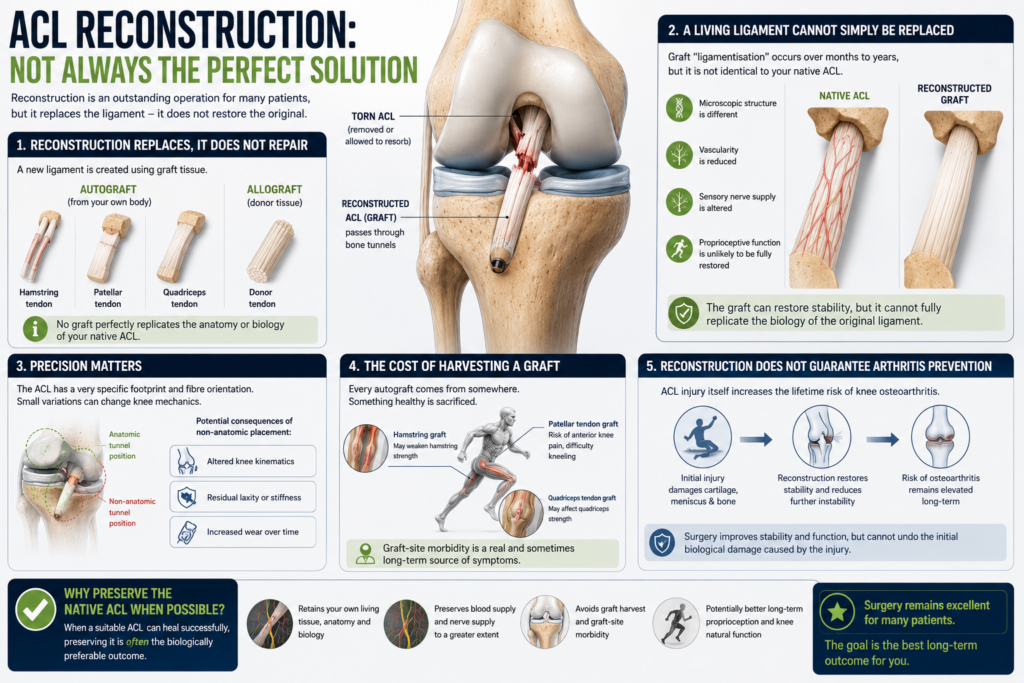
Reconstruction Does Not Repair the ACL
One of the most common misconceptions amongst patients is that surgeons “repair” the torn ACL.
In reality, this rarely occurs.
Instead, the damaged ligament is removed or allowed to resorb, and a completely new ligament is constructed using graft tissue.
This graft may come from the patient’s own body (an autograft) or from donated tissue (an allograft).
The commonest autografts include:
- hamstring tendon
- patellar tendon
- quadriceps tendon
Each has advantages.
Each has disadvantages.
No graft perfectly reproduces the anatomy or biology of the native ACL.
The operation therefore represents one of reconstruction rather than restoration.
This distinction is important.
Because although reconstruction can reproduce much of the ACL’s mechanical function, reproducing its biological function is considerably more difficult.
A Living Ligament Cannot Simply Be Replaced
Earlier, we discussed the ACL as a living neurovascular organ rather than simply a rope inside the knee.
This becomes particularly relevant when considering reconstruction.
A tendon graft provides excellent structural strength.
Over time it incorporates into bone tunnels, undergoes biological remodelling and eventually behaves much more like a ligament than the tendon from which it originated.
This process—known as ligamentisation—is remarkable.
However, even after successful maturation, the reconstructed graft is not identical to the ligament with which the patient was born.
Its microscopic structure differs.
Its vascularity differs.
Its sensory nerve supply is altered.
Most importantly, its proprioceptive function is unlikely to be completely restored.
While surrounding tissues and the nervous system compensate extraordinarily well through rehabilitation, a reconstructed ACL can never entirely replicate the complex biological architecture of the original ligament.
This is one reason why modern rehabilitation extends far beyond simply strengthening muscles.
It focuses heavily on balance, movement quality, reaction time and neuromuscular retraining.
The objective is not merely to strengthen the knee.
It is to retrain the brain.
Precision Matters
The ACL occupies an extraordinarily precise position within the knee.
It originates from the femur and inserts onto the tibia with remarkable anatomical accuracy.
Its fibres tighten and relax throughout knee movement, changing tension continuously as the joint flexes, extends and rotates.
During reconstruction, surgeons attempt to recreate this anatomy by drilling tunnels within the femur and tibia before passing the graft through them.
Modern surgical techniques have become exceptionally sophisticated, and outcomes continue to improve.
Nevertheless, recreating nature perfectly remains impossible.
Even very small variations in tunnel placement, graft orientation or graft tension alter the mechanics of the reconstructed knee.
This is not a criticism of surgery.
It simply reflects the extraordinary complexity of human anatomy.
Nature has had millions of years to refine the ACL.
Replicating that anatomy surgically remains one of the greatest technical challenges in sports orthopaedics.
The Cost of Harvesting a Graft
Another consideration is something patients often do not appreciate before surgery.
Every autograft must come from somewhere.
If the hamstring tendons are used, part of an otherwise healthy muscle-tendon unit is sacrificed to reconstruct the knee.
If the quadriceps tendon is harvested, the extensor mechanism is altered.
If a patellar tendon graft is chosen, patients may experience persistent anterior knee pain or difficulty kneeling.
None of these complications are inevitable.
Indeed, most patients recover extremely well.
However, every graft choice involves compromise.
This is known as graft-site morbidity.
Ironically, one of the commonest long-term sources of discomfort after successful ACL reconstruction is not the reconstructed ligament itself, but the site from which the graft was taken.
This reality is one of the reasons clinicians have renewed interest in preserving the patient’s own ACL whenever that is biologically achievable.
If the native ligament can heal successfully, no graft needs to be harvested.
No healthy tendon needs to be sacrificed.
Does Reconstruction Prevent Arthritis?
Patients frequently assume that reconstruction surgery prevents arthritis from developing later in life.
Unfortunately, the evidence is more complex.
An ACL injury substantially increases the lifetime risk of knee osteoarthritis regardless of how it is treated.
Reconstruction restores stability and reduces recurrent episodes of giving way, which are themselves harmful to the joint.
However, current evidence has not consistently demonstrated that ACL reconstruction completely prevents the later development of osteoarthritis.
Part of this reflects the fact that the initial injury itself often damages cartilage, menisci and subchondral bone.
In other words, some of the biological processes leading towards arthritis begin on the day the ligament ruptures.
Surgery cannot completely reverse that initial insult.
It can, however, reduce further instability and protect the joint from additional injury.
Understanding this distinction is important.
Reconstruction should never be viewed as simply “preventing arthritis.”
Rather, it aims to restore stability, improve function and reduce the risk of further damage to the knee.
So Why Preserve the Native ACL?
If reconstruction works so well, why has there been such excitement surrounding ACL healing?
The answer lies in one simple principle that applies throughout medicine.
Whenever possible, preserving normal human anatomy is preferable to replacing it.
A healed native ACL retains the patient’s own collagen architecture.
It remains biologically integrated within the knee.
Its blood supply, cellular environment and sensory function are preserved to a far greater extent than any reconstruction can currently achieve.
If the ligament heals successfully, the patient avoids graft harvest, avoids graft-site morbidity and retains their own biological tissue.
That represents the ideal outcome.
The challenge, of course, is that not every ACL possesses the capacity to heal in this way.
The crucial question therefore becomes:
How do we identify the patients in whom this is realistically possible?
That question led directly to the development of the Cross Bracing Protocol.
Rather than treating every ACL rupture identically, clinicians began asking which injury patterns retained sufficient biological integrity to justify an attempt at preservation.
That change in thinking represents one of the most important developments in contemporary sports medicine.