
Cortisone Injections for Osteoarthritis: When They Help—and When They Don't
- Dr Mohammad Jomaa
- Jul 5, 2026
- 8 min read
When people are diagnosed with osteoarthritis, the treatment pathway can often feel discouraging.
Many patients are advised to lose weight, strengthen the muscles around the joint, attend physiotherapy, and take pain relief as required. These are all important foundations of treatment. But after months or years of living with pain, many patients are left feeling as though they have only two options: continue to deteriorate or eventually undergo joint replacement surgery.
Fortunately, our understanding of osteoarthritis has evolved considerably.
We now recognise that osteoarthritis is not simply a condition of “wear and tear.” It is a complex disease involving the cartilage, bone, lining of the joint (synovium), muscles, metabolism, inflammation, and even the nervous system. That evolving knowledge has created opportunities to better manage symptoms, slow progression in some patients, and help people remain active for much longer.
In my previous article, I discussed the lifestyle and rehabilitation strategies that form the foundation of osteoarthritis management. This article focuses on one of the most commonly used injectable treatments available: corticosteroid (cortisone) injections.
What is a cortisone injection?
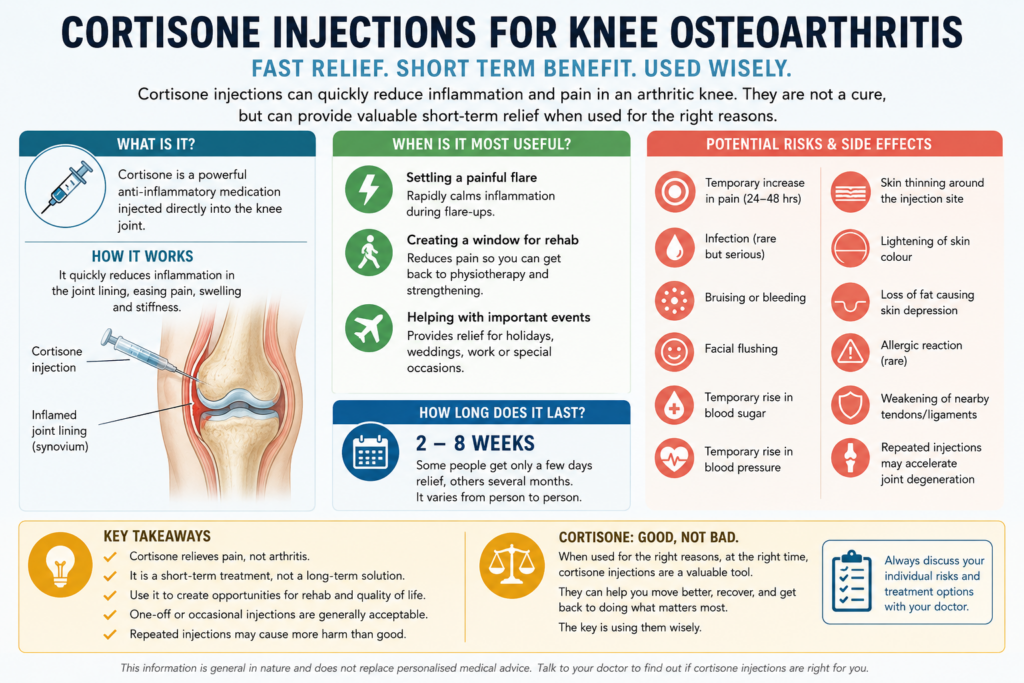
Cortisone is a powerful anti-inflammatory medication.
When injected into an arthritic joint, its primary purpose is to rapidly suppress inflammation within the joint lining. This often leads to a noticeable reduction in pain over the following few days.
For many people, the improvement can be dramatic.
However, it is important to understand exactly what cortisone is—and what it isn’t.
Cortisone treats inflammation—not arthritis
One of the biggest misconceptions is that cortisone “fixes” arthritis.
It doesn’t.
It doesn’t regenerate cartilage.
It doesn’t rebuild damaged bone.
It doesn’t reverse osteoarthritis.
Instead, it works by temporarily reducing the inflammatory chemicals that are contributing to pain.
Think of it like turning down the volume on an alarm system. The alarm becomes quieter, but the underlying reason it went off hasn’t necessarily changed.
How long does it last?
The duration of benefit varies enormously between individuals.
Most patients experience meaningful relief for somewhere between 2 and 8 weeks.
Some obtain only a few days of improvement.
Others may enjoy several months of reduced pain.
The response depends on many factors including:
- the severity of arthritis
- how inflamed the joint is
- activity levels
- body weight
- muscle strength
- overall health
Unfortunately, cortisone should not be viewed as a long-term solution.
When is cortisone most useful?
Despite its limitations, cortisone remains a very useful tool when used appropriately.
Some of the situations where I commonly recommend it include:
Settling a painful flare
Osteoarthritis often fluctuates.
A patient who has been coping reasonably well may suddenly develop a significant inflammatory flare after increased activity, an awkward twist, or seemingly for no obvious reason.
Reducing inflammation during these episodes can help settle symptoms much more quickly.
Creating a window for rehabilitation
Pain inhibits movement.
When pain is severe, people naturally become less active.
They stop walking.
They stop strengthening.
They lose muscle.
Their balance worsens.
Their arthritis then becomes even more symptomatic.
A cortisone injection can sometimes create a valuable opportunity where pain is sufficiently reduced to allow patients to recommence physiotherapy, strengthen the surrounding muscles, improve fitness, and regain confidence.
In these situations, the injection is not the treatment.
It simply creates the opportunity for the real treatment—rehabilitation—to occur.
Helping people through important life events
Sometimes life doesn’t wait for arthritis.
Patients may have:
- an overseas holiday
- their child’s wedding
- an important family celebration
- a once-in-a-lifetime trip
- significant work commitments
Using cortisone strategically to improve function during these important periods can be entirely appropriate.
Why don’t we simply keep repeating cortisone injections?
This is where the conversation becomes more nuanced.
Inflammation exists for a reason.
Although excessive inflammation contributes to pain, inflammation is also one of the body’s natural repair and housekeeping processes.
Repeatedly suppressing this response may have consequences.
Research over the past decade has shown that repeated corticosteroid injections into osteoarthritic joints may accelerate structural degeneration in some patients. Studies have demonstrated greater cartilage volume loss following repeated injections compared with placebo, even when pain initially improves.
For this reason, most sports and exercise physicians use cortisone thoughtfully rather than routinely.
A single injection—or occasional injections spaced appropriately throughout the year—is generally considered reasonable when there is a clear clinical indication.
However, repeatedly injecting the same joint every few months simply because symptoms return is rarely the best long-term strategy.
Each injection should have a clear purpose.
Are cortisone injections safe?
Overall, cortisone injections are considered very safe when performed correctly by experienced clinicians.
Serious complications are uncommon.
However, like all medical procedures, there are potential side effects and risks.
These include:
- Temporary increase in pain for 24–48 hours after the injection (“post-injection flare”)
- Infection (rare, but one of the most important complications)
- Bleeding or bruising
- Temporary facial flushing
- Temporary rise in blood sugar levels, particularly in people with diabetes
- Temporary elevation in blood pressure in some patients
- Skin thinning around the injection site
- Lightening of skin colour (skin depigmentation)
- Loss of subcutaneous fat causing a small skin depression
- Allergic reaction (rare)
- Temporary suppression of the body’s own cortisol production after large or repeated doses
- Potential weakening of nearby tendons or ligaments if medication is inadvertently injected into these structures
- Accelerated cartilage degeneration with repeated injections into the same joint over time
This last point deserves particular emphasis.
Sports and exercise physicians are especially cautious about injecting cortisone into tendons because repeated exposure can weaken tendon tissue and increase the risk of tendon rupture. The same philosophy increasingly applies to arthritic joints—we aim to minimise unnecessary repeated exposure wherever possible.
So, is cortisone “good” or “bad”?
The answer is neither.
Cortisone has developed something of a bad reputation in recent years, largely because we now better understand its limitations.
But that doesn’t mean it should be abandoned.
Used thoughtfully, cortisone remains an excellent medication.
It can rapidly relieve pain, improve function, allow rehabilitation to begin, and help patients through particularly difficult periods.
The key is recognising what it is designed to do.
It is a symptom-relieving injection, not a joint-restoring injection.
When used for the right reasons, in the right patient, and at the right time, it remains one of the most valuable tools we have.
When used repeatedly as a substitute for comprehensive arthritis management, however, it risks becoming part of the problem rather than the solution.
Looking ahead
Cortisone is only one of several injectable therapies available for osteoarthritis.
In the next article, we’ll explore hyaluronic acid (“joint lubricant”) injections, including how they work, who they may benefit, what the evidence shows, and how they compare with cortisone.