
Understanding Tendinopathy: What is it and why does it occur?
- Dr Mohammad Jomaa
- Jul 5, 2026
- 8 min read
Almost everybody knows someone who has struggled with “tennis elbow”, Achilles pain, rotator cuff problems or persistent pain around the knee or hip. Tendon injuries are among the most common reasons people seek help from a Sports & Exercise Physician, yet they are also among the most misunderstood.
Many patients are told simply to “rest”, “stop exercising”, or “wait for it to settle.” Others are prescribed anti-inflammatory medication or undergo repeated scans without ever being given a clear explanation of what is actually happening inside the tendon.
Understanding your injury is often the first step towards recovering from it.
The aim of this article is to explain what tendinopathy actually is, why it develops, why it can sometimes be frustratingly slow to heal, and—most importantly—what you can do to help your tendon recover. Although every tendon injury is slightly different, the underlying principles are remarkably similar, regardless of whether the problem is affecting your shoulder, elbow, hip, knee or Achilles tendon.
This article is designed to help you understand those principles so that you can become an active participant in your own recovery.
What Is a Tendon?
A tendon is a remarkably strong piece of living tissue whose job is to attach muscle to bone.
Every time you move a joint, your muscles contract, generating force. That force must then be transmitted to the skeleton in order to create movement. Tendons are the structures responsible for transferring that force.
Although we often think of tendons as being like ropes, a better analogy is to think of them as something between a heavy-duty elastic band and a bungee cord.
They are designed to be incredibly strong while also storing and releasing energy with every movement.
When you walk, climb stairs, jump or run, your tendons stretch slightly before recoiling again. This elastic property allows movement to become more efficient while reducing the amount of work your muscles have to perform.
However, unlike a climbing rope, tendons are living tissue.
They are constantly breaking down old collagen fibres and replacing them with new ones. They adapt throughout life according to the demands placed upon them.
If they are exposed to regular, consistent loading, they become stronger and better able to tolerate that load.
If they are overloaded too quickly—or not loaded enough—they begin to lose that capacity.
Understanding this principle forms the foundation of almost everything we know about treating tendinopathy.
What Is Tendinopathy?
Quite simply, tendinopathy means a disease or disorder affecting a tendon.
Many people still use the older term tendonitis, but in reality this is usually not the correct diagnosis.
The suffix “-itis” means inflammation.
While inflammation certainly plays a role in the earliest stages of tendon injury, by the time most patients present to a Sports & Exercise Physician or physiotherapist, the tendon has usually progressed beyond a purely inflammatory process.
Instead, the tendon has begun undergoing structural and cellular changes.
For this reason, the broader term tendinopathy is now preferred.
This distinction may seem like semantics, but it is actually important because it influences how we think about treatment.
If a problem is purely inflammatory, then reducing inflammation becomes the primary goal.
If, however, the tendon has undergone degeneration, weakening and changes in collagen structure, then simply reducing inflammation is unlikely to solve the underlying problem.
Instead, successful treatment focuses on restoring the health and function of the tendon itself.
How Does Tendinopathy Develop?
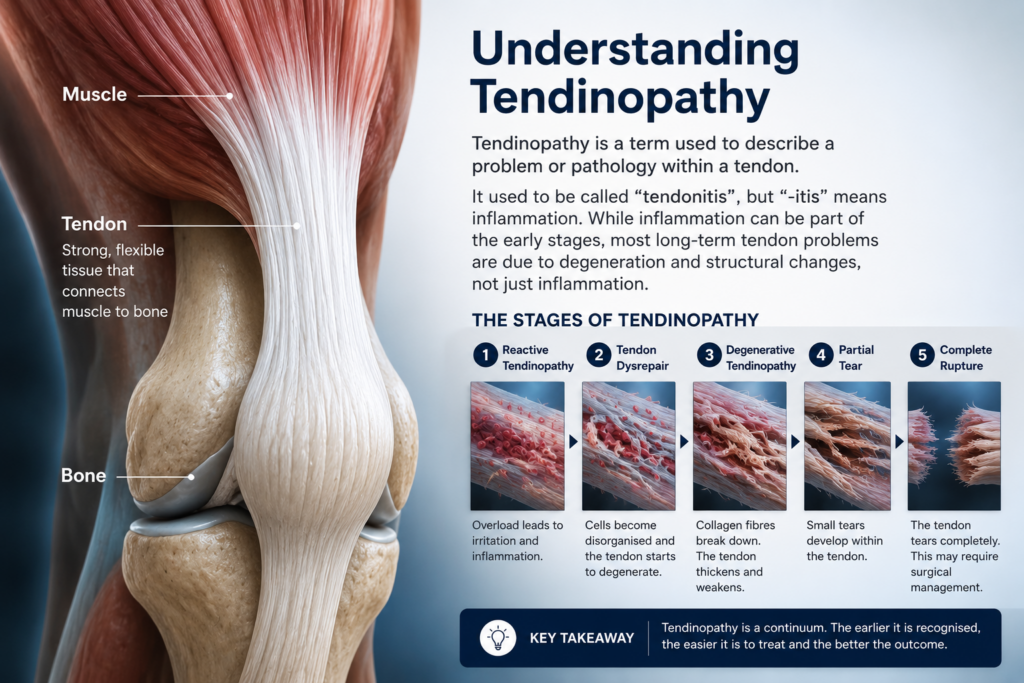
Although every tendon injury is unique, tendinopathy generally progresses through a series of recognisable stages.
For patients, it is easiest to think of this as a gradual spectrum rather than a sudden injury.
Stage 1 – Early Irritation
Initially, a tendon becomes irritated following an increase in load.
At this stage there is often a relatively greater inflammatory response, and the tendon may become sore, swollen or stiff.
If the cause is recognised early and the loading is appropriately modified, recovery at this stage is often relatively straightforward.
Stage 2 – Tendon Degeneration
If excessive loading continues without adequate recovery, the tendon begins to change internally.
Rather than producing well-organised collagen fibres, the body starts laying down tissue that is less organised and mechanically weaker.
The tendon often becomes thicker as it attempts to compensate for these changes.
Although this thicker tendon may appear stronger from the outside, the quality of the tissue has actually declined.
This is the stage where many patients first seek medical attention.
Stage 3 – Partial Tearing
As degeneration progresses, small tears may begin developing within the tendon.
These are commonly called partial-thickness tears.
At this stage, patients often notice increasing pain during activity and more persistent stiffness afterwards.
Stage 4 – Complete Rupture
If degeneration becomes severe and the tendon is subjected to a sufficiently large force, complete rupture may occur.
Instead of simply becoming painful, the tendon tears completely apart.
Some tendon ruptures require surgery, while others can be managed without an operation depending on the tendon involved.
The important point is that many complete ruptures begin as smaller, more manageable tendon problems months or even years beforehand.
Early recognition and appropriate management may help reduce the risk of progression.
Tendons Are Living Tissue—Not Just Mechanical Ropes
One of the biggest misconceptions surrounding tendon injuries is that tendons are simply mechanical structures.
Patients often think of them like the cable on a bicycle brake.
Once damaged, they assume they simply need time to “stick back together.”
In reality, tendons behave much more like living organs than pieces of rope.
Every tendon contains specialised cells responsible for continually repairing and maintaining collagen fibres.
These cells constantly respond to the environment around them.
When loading is appropriate, they strengthen the tendon.
When loading becomes excessive, too sudden or too inconsistent, they struggle to keep pace with the damage occurring.
The balance gradually shifts away from repair and towards degeneration.
This is why understanding tendons as biological tissue, rather than simply mechanical tissue, is so important.
Successful rehabilitation isn’t simply about protecting the tendon.
It’s about creating the biological conditions that allow healthy tendon tissue to be rebuilt.
What Does Tendon Pain Feel Like?
Although every patient experiences pain differently, tendinopathy often follows a surprisingly recognisable pattern.
Patients commonly describe it as:
- Tightness
- Soreness
- Stiffness
- An aching pain that appears with loading
One of the hallmark features of tendon pain is that it often feels worst after periods of rest.
For example, someone with Achilles tendinopathy frequently tells me:
“The first few steps in the morning are terrible—but once I get moving, it actually feels much better.”
This is a classic tendon story.
Similarly, many people find that the pain eases once they have “warmed up” during exercise.
Unfortunately, the relief is often temporary.
A few hours later—or the following morning—the stiffness and soreness return once the tendon has “cooled down” again.
Understanding this pattern is helpful because it allows us to distinguish tendinopathy from many other causes of musculoskeletal pain.
More importantly, it reassures patients that feeling somewhat better during activity doesn’t necessarily mean they have caused further damage.
Why Do Tendons Heal So Slowly?
One of the most frustrating aspects of tendon injuries is how long they can take to recover.
Patients are often surprised that a muscle strain may improve within weeks, while tendon pain can persist for months.
The reason lies partly in the way tendons receive their nutrition.
Muscles, skin and bone all have an excellent blood supply.
Blood vessels continuously deliver oxygen, nutrients and repair cells while removing waste products.
Tendons are different.
Compared with muscle, tendons have a much more limited direct blood supply.
Much of their nutrition reaches them through diffusion from surrounding tissues rather than through a dense network of blood vessels.
This makes tendon metabolism naturally slower.
As a result, the processes responsible for repairing damaged collagen also occur more slowly.
This does not mean tendons cannot heal.
It simply means that patience and appropriate rehabilitation becomes far more important.
Many patients become discouraged because they expect tendon injuries to behave like muscle injuries.
In reality, tendon rehabilitation is measured in months rather than days or weeks.
Setting realistic expectations from the beginning is one of the most important parts of successful treatment.
In the next section in this series on Tendinopathy, we’ll cover why tendinopathy develops, why it most commonly affects adults between 30 and 70 years of age, the concept of load management, why so many tendon injuries appear after seemingly minor lifestyle changes, and why understanding the boom-and-bust cycle is often the key to finally overcoming persistent tendon pain.
https://shorturl.fm/1zrdo