Understanding Tendiopathy: Beyond Exercise - Additional tools for tendiopathy
- Dr Mohammad Jomaa
- Jul 5, 2026
- 8 min read
Additional Treatments That May Help
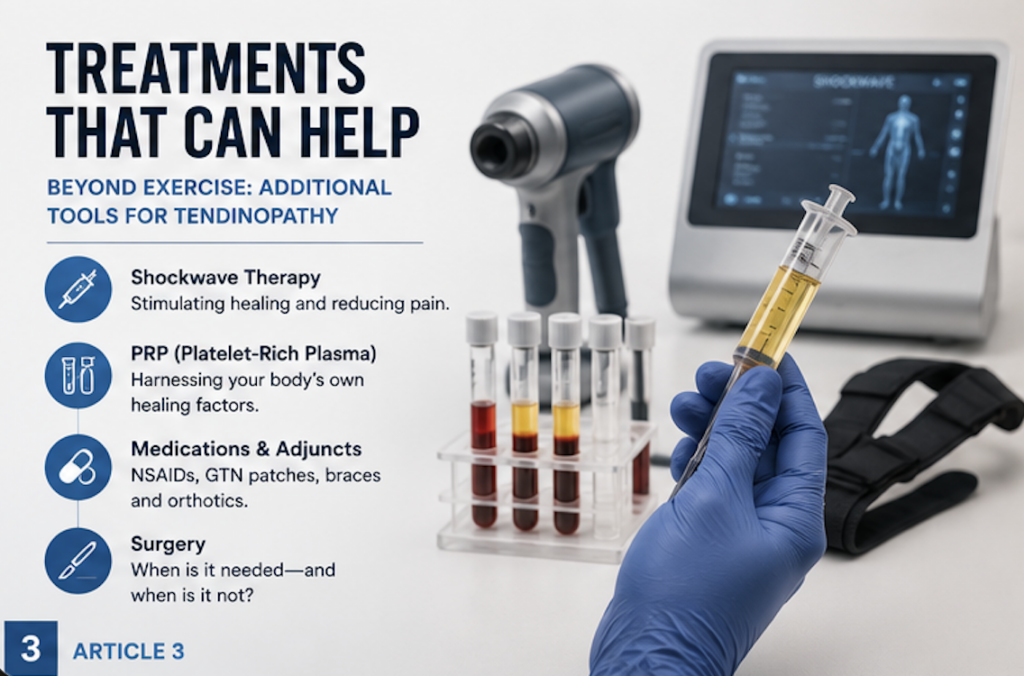
Appropriate rehabilitation and load management remain the foundation of successful tendon treatment.
However, there are a number of additional therapies that may complement a well-designed rehabilitation programme.
Not every treatment is appropriate for every patient, and the best choice depends on the specific tendon involved, the stage of tendinopathy and the individual’s goals.
Platelet-Rich Plasma (PRP)
One of the most exciting developments in Sports and Regenerative Medicine has been the increasing use of Platelet-Rich Plasma, or PRP, for selected tendon injuries.
PRP begins with a simple blood sample taken from your own arm.
That blood is then processed so that the platelets—which contain a high concentration of naturally occurring growth factors—become concentrated into a much smaller volume.
These platelets are then carefully injected into and around the injured tendon under ultrasound guidance.
Patients often ask me:
“If my blood is already circulating around my body, why would concentrating it make any difference?”
The answer lies in understanding how the body naturally heals injuries.
Whenever you cut your skin or injure a muscle, platelets are among the very first cells to arrive.
Most people think their job is simply to stop bleeding.
In reality, platelets are also remarkable biological communicators.
They release hundreds of chemical signals that coordinate healing.
They recruit repair cells.
They influence inflammation.
They regulate collagen production.
In many ways, they behave less like bricks and more like the site managers on a building project.
The builders cannot work efficiently without someone coordinating where the materials go, what order jobs should occur, and how the overall project should progress.
PRP attempts to reintroduce a high concentration of these biological “site managers” into a tendon whose healing response has often become stagnant.
Rather than simply masking pain, the aim is to encourage the body to restart a more organised healing process.
Current evidence suggests that PRP may be beneficial for carefully selected chronic tendinopathies, particularly when combined with an appropriate rehabilitation programme.
It is not a miracle cure.
Nor does every tendon respond equally.
However, for the right patient, at the right stage of disease, it has become an important part of modern regenerative sports medicine.
Extracorporeal Shockwave Therapy
Shockwave therapy has become an increasingly common treatment for chronic tendinopathy.
Despite its name, it is not an electrical treatment.
Instead, the machine delivers high-energy sound waves into the affected tendon.
These sound waves pass harmlessly through softer tissues before being absorbed more readily by denser structures such as tendon and bone.
Exactly how shockwave works remains an area of ongoing research.
It probably works through several different biological mechanisms rather than just one.
One proposed mechanism is that it helps disrupt areas of poorly organised healing, encouraging the body to begin laying down healthier tendon tissue.
Another appears to involve stimulating cellular activity and blood vessel formation within the tendon.
It may also help reduce pain by influencing the way nerves process painful signals.
When explaining shockwave to patients, I often use the analogy of building a brick wall.
Imagine asking a skilled bricklayer to construct a wall.
Normally, each brick would be carefully positioned with a thin, even layer of mortar, producing a wall that is both neat and incredibly strong.
Now imagine someone becoming impatient.
Instead of carefully laying each brick, they simply tip an entire wheelbarrow full of bricks into a pile and pour cement over the top.
The wall may end up looking thick and substantial, but structurally it is weak.
The bricks are poorly aligned.
Small knocks cause pieces to chip away.
In many ways, this resembles what happens during chronic tendinopathy.
The body tries to repair itself, but the collagen fibres become disorganised.
The tendon becomes thicker, yet mechanically weaker.
Shockwave appears to encourage the body to clear away some of this poor-quality repair tissue, creating a better scaffold upon which healthier tendon can gradually be rebuilt.
Like every analogy, this is a simplification—but it captures the principle surprisingly well.
Anti-inflammatory Medication
Non-steroidal anti-inflammatory medications (NSAIDs), such as ibuprofen or naproxen, are commonly used during the early stages of tendon pain.
They can reduce pain, stiffness and inflammation, particularly when the tendon has recently become irritated.
However, it is important to understand what these medications are actually doing.
For many patients, they improve symptoms far more than they improve tendon healing itself.
In other words, they are often better thought of as pain-modifying medications rather than tendon-healing medications.
As tendinopathy becomes more chronic and degenerative, inflammation becomes a smaller part of the problem.
At that stage, rehabilitation and load management become increasingly important.
Glyceryl Trinitrate (GTN) Patches
GTN patches have been used in Sports Medicine for many years.
Although they are prescribed less commonly today than they were a decade ago, they remain a useful option for selected patients.
GTN causes small blood vessels to dilate.
The theory is that improving local blood flow may encourage tendon healing while also reducing pain.
The evidence is mixed, and they are certainly not appropriate for everyone, but they remain another tool that can occasionally be incorporated into a broader treatment plan.
Surgery
Fortunately, most tendinopathies never require surgery.
The overwhelming majority improve through a combination of education, appropriate rehabilitation and carefully managed loading.
Surgery is generally reserved for situations where there has been a complete tendon rupture, significant structural failure, or where prolonged, well-conducted conservative treatment has genuinely failed.
One of the reasons I encourage patients to seek assessment early is that many tendon problems can be successfully managed before they progress to this stage.
https://shorturl.fm/DFFTT
https://shorturl.fm/eHEnx
https://shorturl.fm/IYFaT
https://shorturl.fm/TGhci
https://shorturl.fm/62HDZ
https://shorturl.fm/WJbP7
https://shorturl.fm/wHch2
https://shorturl.fm/wCeOT
https://shorturl.fm/jh3fl