
Acute ACL Injuries: Why You Might Not Need Surgery
Part 2: ACL Healing. Why we thought it couldn't. Why we know it can.
- Dr Mohammad Jomaa
- Jul 31, 2026
- 8 min read
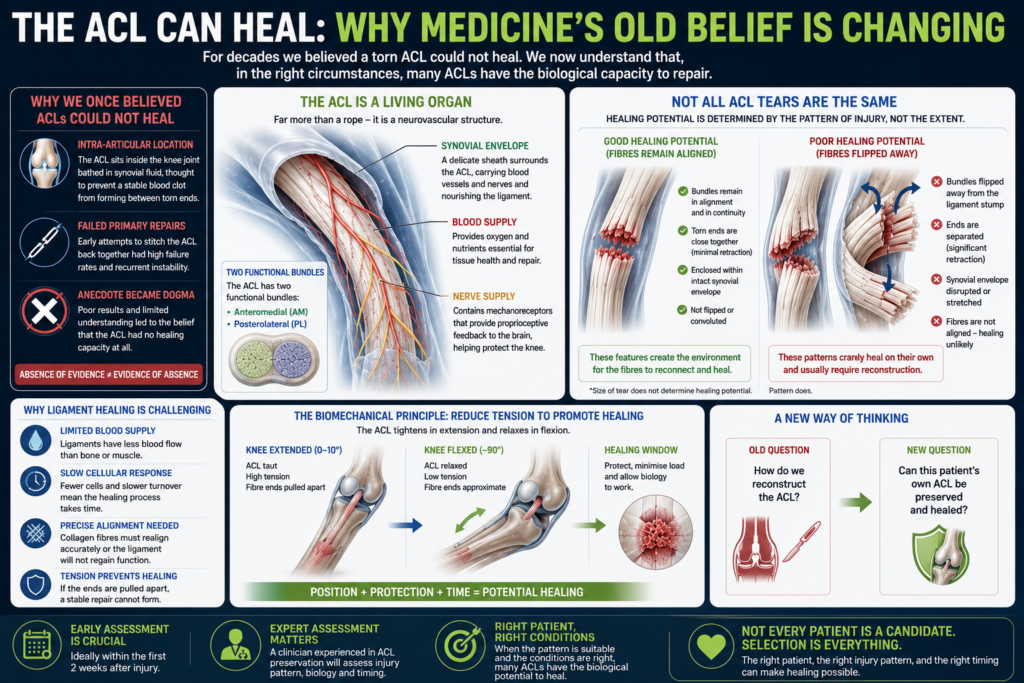
“For decades, tearing your ACL almost automatically meant surgery. Today, our understanding of how this remarkable ligament functions—and, importantly, how it may heal—is changing.”
Introduction
Few injuries strike more fear into an athlete than hearing the words:
“You’ve torn your ACL.”
For good reason.
Compared with almost every other sporting injury, an anterior cruciate ligament (ACL) rupture usually carries the longest rehabilitation, the greatest uncertainty, and perhaps the biggest psychological impact. Even for elite athletes with access to world-class medical care, returning to competitive sport commonly takes 9–12 months, and many do not feel fully confident in their knee until 18–24 months after injury. Even then, not every athlete returns to their previous level of performance.
For decades, treatment was considered straightforward. Tear your ACL, reconstruct it surgically, complete a long rehabilitation programme and return to sport.
Today, however, that conversation is changing.
Over the last several years, our understanding of ACL anatomy, biomechanics and healing biology has evolved considerably. Carefully conducted research has demonstrated that some ACL injuries possess a genuine capacity to heal, allowing selected patients to return to high-level function without requiring reconstruction surgery.
This does not mean surgery is obsolete.
Far from it.
ACL reconstruction remains an excellent operation for many patients and continues to play an essential role in modern sports medicine. However, it is no longer appropriate to assume that every ACL rupture automatically requires reconstruction.
The first step towards understanding why is appreciating that the ACL is not simply a rope that prevents the knee from moving.
It is a living organ.
The ACL Is More Than a Cord
Patients often imagine the ACL as a thick cord inside the knee whose only purpose is to stop the bones moving too far.
While this description is simple, it is also incomplete.
The anterior cruciate ligament is a highly specialised living structure. It contains an organised collagen framework, a dedicated blood supply and an extensive network of sensory nerve endings that continuously communicate with the brain and spinal cord.
In other words, the ACL does far more than mechanically restrain movement.
It constantly monitors movement.
Like many other ligaments throughout the body, the ACL functions as a biological sensor. Whenever excessive tension develops within the ligament, specialised nerve endings detect that stretch and immediately relay information through the spinal cord. Within fractions of a second, the surrounding muscles respond reflexively to stabilise the knee before injury occurs.
This process is known as proprioception—the body’s remarkable ability to know where its joints are in space without consciously looking at them.
The ACL therefore acts as both a restraint and an early warning system.
Only when these muscular protective mechanisms are overwhelmed does the ligament itself become the final line of defence.
When that happens, it ruptures.
Understanding this point fundamentally changes how we think about ACL injuries.
Rather than viewing the ligament as a passive piece of tissue that simply tears, we begin to recognise it as a living neurovascular structure whose biological function extends well beyond mechanical stability.
That distinction becomes critically important when considering whether it may also possess the ability to heal.
What Is the ACL?
The anterior cruciate ligament (ACL) is one of two cruciate ligaments located deep within the centre of the knee. The word cruciate originates from the Latin crux, meaning “cross”, describing how the anterior cruciate ligament crosses with the posterior cruciate ligament (PCL) inside the joint.
Although these two ligaments work together to provide stability, each performs a slightly different role.
The ACL becomes progressively tighter as the knee straightens, making it particularly important when standing upright, running, landing and changing direction.
The PCL behaves almost opposite to this. It becomes most taut when the knee is bent, helping stabilise the joint during squatting, kneeling and landing directly onto a flexed knee.
This simple relationship explains why the two ligaments are usually injured through very different mechanisms.
The ACL most commonly ruptures while an athlete is upright and attempting to pivot or rapidly change direction.
The PCL, in contrast, is more frequently injured when the knee is already bent, such as falling directly onto the front of the knee or striking the dashboard during a motor vehicle accident.
Why Does the ACL Tear?
One of the greatest misconceptions surrounding ACL injuries is that they usually occur because somebody collided with the athlete.
In reality, approximately 70% of ACL ruptures are non-contact injuries.
The athlete simply plants their foot, attempts to pivot or decelerate, and the knee suddenly gives way.
Typically, the knee collapses inward into what clinicians describe as a dynamic valgus position while the tibia simultaneously rotates relative to the femur.
This combination places enormous tension through the ACL.
Imagine twisting the fibres of a thick climbing rope whilst simultaneously pulling on it.
Initially the fibres stretch.
Eventually they begin separating.
Finally, multiple collagen bundles fail almost simultaneously.
This is much closer to what occurs during an ACL rupture than imagining the ligament snapping cleanly in half.
Importantly, many ACL ruptures leave portions of the ligament still connected.
Some fibre bundles remain continuous.
Others remain enclosed within the delicate synovial tissue that surrounds the ligament.
As we shall see later, this seemingly small anatomical detail may determine whether the ligament retains the biological capacity to heal.
Why ACL Injuries Are So Devastating
The devastation caused by an ACL injury extends far beyond the moment the ligament ruptures.
For the athlete, it often represents the sudden loss of an entire season.
For professionals, it may threaten contracts and careers.
For recreational athletes, it can remove an important source of identity, fitness, confidence and social connection.
Even after successful rehabilitation, many athletes report that regaining trust in the injured knee takes considerably longer than regaining strength.
This is hardly surprising.
The ACL contributes not only mechanical stability but also proprioceptive feedback. Once injured, the nervous system temporarily loses one of its most sophisticated sensors of knee position and movement.
Recovery therefore requires far more than rebuilding muscle.
It requires retraining the entire neuromuscular system.
Historically, reconstruction surgery has been regarded as the most reliable means of restoring stability for athletes wishing to return to pivoting sports. While reconstruction remains an outstanding procedure for many patients, it is important to recognise what it actually achieves—and equally, what it cannot fully replace.
That distinction forms the basis of one of the most important paradigm shifts currently occurring in sports medicine.
Because if the native ACL is indeed a living, vascular, neurologically active organ rather than merely a passive restraint, perhaps our first question should no longer be:
“How do we replace it?”
Instead, perhaps we should first ask:
“Can we help it heal?”